
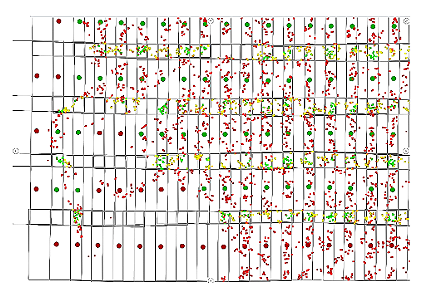
Aerotriangulation is the process of densifying the Control Points used to correlate aerial images with the mapping's Coordinate System, starting from a few points with known coordinates in both systems (photo and terrain). The goal of aerotriangulation is to orient the captured images so that any point queried within them has a coordinate related to a previously defined system. It is an essential step for carrying out photogrammetric restitution and orthorectification activities.
The orientation of images in the aerotriangulation process for conventional photos is carried out by reading model and strip points. The so-called tie points between models are chosen along the center line of the photo within the longitudinal overlap zone. The tie points between strips are chosen in the lateral overlap zones, in locations of the photographs where sharpness and contrast were considered good, where details appear well defined on the ground and outside a 1.5 cm band from the edge of the images.
In the aerotriangulation process for digital camera images, these points are distributed along the entire strip and read in at least three images. The advantage of using digital images is the high radiometric resolution and very precise positioning, which allows model points to be read automatically through image correlation. This brings a considerable reduction in time compared to conventional methods of reading model points in non-digital images.
Control points or supplementary support points are points with coordinates measured in the field through geodetic surveys. The identification of control points on the images is done through sketches or photos created during the field survey process. Control points are measured exclusively by hand and in a stereo environment, ensuring precise positioning as well as the correct interpretation of the feature used as support.
The STRIP TIE POINTS (link points) are chosen in the lateral overlap zones, in locations of the photographs where sharpness and contrast were considered good, where details appear well defined on the ground and outside a 1.5 cm band from the edge of the film.
For a flight with a digital camera, control points are limited to the minimum necessary to define the datum, being positioned at the corners of the blocks. The strips are geometrically stable due to GPS/IMU system data.
Related Articles
- Digital Aerotriangulation