
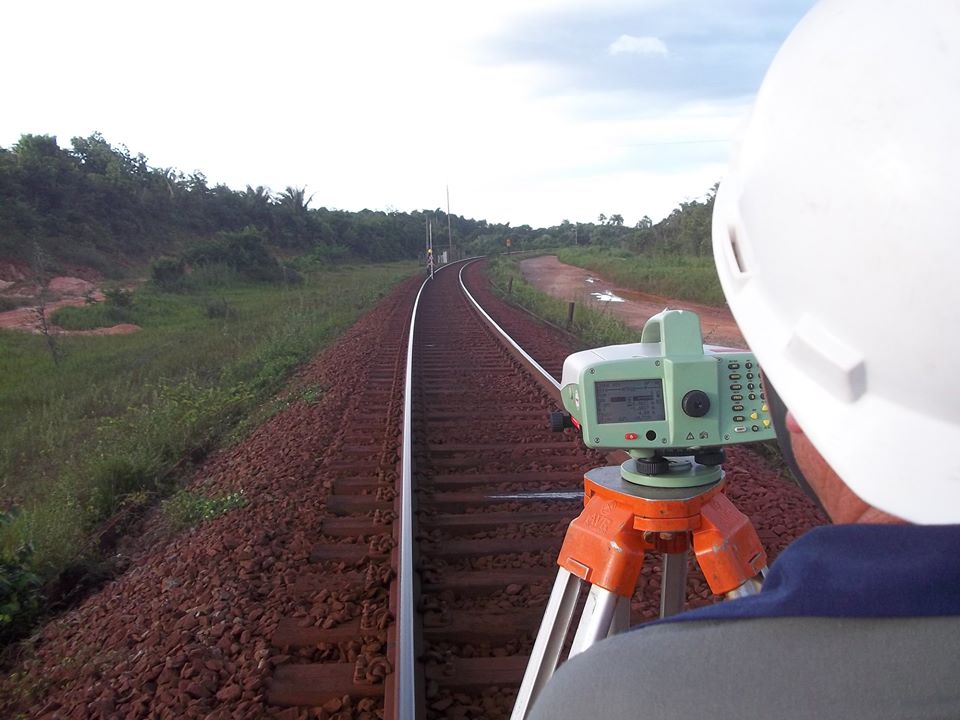
Ground control aims to obtain coordinates on the terrain surface using modern measurement technologies, seeking to obtain planimetric and altimetric coordinates. These coordinates are obtained with state-of-the-art equipment, receiving signals from the GPS, GLONASS and Galileo satellite constellations, forming GNSS (Global Navigation Satellite System), or using total stations and high-precision electronic levels.
To facilitate distribution across the terrain, aiming at point densification and precision (quality) classification, ground control is divided into basic and supplementary, also referred to as primary and secondary.
The techniques used to obtain the final result may vary according to equipment models and terrain conditions encountered.
Basic Support
Basic Support Points are points measured on the ground with centimetric precision and are used to transfer coordinates to the points of the Basic Traverse, which will later serve as the basis for radiating supplementary support points.
The starting and ending points for Basic Support are generally vertices of the High Precision Geodetic Network of the Brazilian Institute of Geography and Statistics (IBGE), the SIRGAS continental network, or any other entity that has established vertices with superior precision.
Supplementary Support
Supplementary or Photogrammetric Support Points are points needed to define the Coordinate System to be adopted in the mapping and its correlation with the photographic image. These points are chosen in strategic positions, taking into account factors such as: distance from slopes, flat regions and accessible locations. Once the points are defined, they are marked on the photos.
Reconnaissance and Materialization
With photographs showing the positions of the marked points, field teams identify each one, analyzing the possibilities of measurement and unequivocal identification of each point in the photos.
Measured points may be materialized in the field with concrete markers (when they will be used for future surveys) or with wooden stakes (when only knowledge of the location's coordinates is needed).
Concrete markers generally have a truncated pyramidal shape, and a bronze plate is usually embedded at the top, on which identification data for the point, the client and the date of execution are stamped.
GNSS Planimetric Measurement
Currently, the geodetic satellite positioning methodology of the American NAVSTAR-GPS (Global Position System) constellation, the Russian GLONASS, and, in the near future, the European Galileo system, is used.
The quality of the measurement depends mainly on the equipment and the tracking time. The result of this measurement is planimetric coordinates for each tracked point, represented in the chosen Coordinate System.
Precise ephemerides may be used to refine solutions, through techniques such as PPP (Precise Point Position).
Planimetric Measurement with Total Station
GNSS technology is limited by signal obstruction in regions with dense vegetation cover, buildings and slopes. These situations can be solved using a Total Station.
Altimetric Measurement
Geometric Leveling aims to determine the altitude of points on the terrain surface (orthometric altitude). Altitude is referenced to mean sea level.
The method used is transferring these altitudes through measurements of the level difference between points on the ground using an Electronic Level.
The determination of orthometric elevations and ellipsoidal elevations allows for the creation of the geoidal map.
Capabilities
ESTEIO performs high-precision topographic services such as:
-
Geodetic Networks with GNSS technology;
-
Computerized Topography with Total Stations;
-
Photogrammetric Support with GNSS technology;
-
Geometric Leveling with Electronic Levels;
-
Preparation of geoidal maps for solution refinement.
High-precision equipment:
-
Dual-frequency Hiper GD GNSS receivers: H: 3mm + 1ppm x D, V: 5mm +1.4 mm x D
-
Dual-frequency Leica 530 GPS receivers (operating in RTK kinematic mode): H: 5mm + 0.5 ppm x D, Kinematic (RTK) 10mm + 1ppm V: 10mm + 1ppm
-
DNA10 Digital Levels: precision of 0.9 mm for double-run leveling over 1 km (invar staff)
Related Articles
-
The Importance of Planning for GPS Survey Missions
-
Real-Time Kinematic Surveying (RTK)
-
Methods for Obtaining Altimetry – Characteristics, Advantages and Application
-
SMS in ESTEIO's Field Activities – Overview