
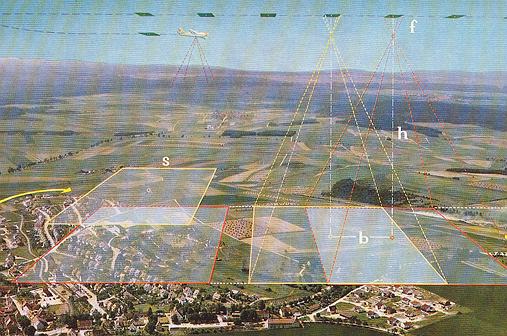
Photogrammetry is the science or technology of obtaining reliable information about physical objects and the environment through processes of recording, measuring and interpreting photographic images.
Aerial Photogrammetry refers to photogrammetric operations carried out with photographs of the earth's surface obtained by a precision camera with the optical axis of the lens system closest to vertical, mounted on a specially prepared aircraft. It is used in Cartography, Urban Planning and Development, Geography, and Civil, Agronomic and Forestry Engineering.
Flight Plan
Using available resources, such as plans, maps of the region, NASA's SRTM, the elements necessary for planning Aerial Photogrammetric Coverage are calculated. Normally, the region of interest is flown through parallel photo strips.
In the accompanying photo, we have:
-
Graphic flight plan;
-
Analytical flight plan;
-
GPS receiver – GARMIN 296-MAP, used for navigation.
Overlaps
If the purpose of the coverage is Mapping of the region, flight lines are planned with spacing such that a common area of around 25% is obtained between strips. This common area is called Side Overlap, or overlap between strips.
Each photograph in a flight line covers an area that overlaps the area covered by the previous photograph by approximately 60%. This overlap between consecutive photographs is called Forward Overlap, or overlap between photos. In the case of coverage intended to obtain orthophotos, the Forward Overlap is 80%.
Aerial Cameras
Special high-precision cameras are used to obtain aerial photographs.
The focal length of the camera is a determining factor for flight altitude and, often, the final use of the images. Focal lengths range from 80 mm to 610 mm, with 153 mm and 300 mm being the most commonly used.
These cameras have a negative frame measuring 25 cm x 25 cm and are equipped with systems that record on the negative, at the moment the photograph is taken, information such as: fiducial marks, flight altitude, camera tilt, sequential number, time of shot, and, in some models, focal length.
Photo Scale
Aerial photographs can be obtained at various scales. The subsequent use of the photograph is what determines which scale is most appropriate.
For more precise mapping, such as urban area cadastres, lower flights are used, with photos at scales from 1:4,000 to 1:10,000 (large and medium scales).
For rural areas, higher flights are normally carried out, with scales from 1:15,000 to 1:40,000 (small scales).
Atmospheric Conditions
Photogrammetric flights are directly linked to the weather conditions of the region to be overflown.
There are strict criteria regarding flight schedules, the presence of fog, mist and especially clouds over the region, which interfere with the quality of the acquired photos.
Aerial Survey License
The execution of flights within national territory is the responsibility of Federal Government organizations and Private Companies that are qualified to perform this type of service.
This qualification is granted through specific registration with the Ministry of Defense, provided that the company demonstrates the technical conditions to carry out the flights.
Each Aerial Photogrammetric Coverage carried out depends on prior granting of a license by the Ministry of Defense, which requires informing the location and boundaries of the area to be surveyed.
Capabilities
ESTEIO carries out flights to obtain aerial photographs at small, medium or large scales with its own aircraft and cameras.
-
Sêneca II, Sêneca III and Navajo aircraft, specially equipped and certified;
-
ZEISS RMK A and RMK TOP aerial cameras with focal lengths of 88, 153 and 300 mm, connected to GPS for supported flights;
-
GPS navigation on the aircraft;
-
Gyro-stabilized platform to correct aircraft movements during flight;
-
Film magazines with FMC (Forward Motion Compensation) to avoid image smearing on low-altitude flights.
Related Articles
-
Weather Conditions Favorable to SAE (Specialized Aerial Service)
-
ESTEIO Begins Process of Replacing Aircraft E.L.T. (Emergency Locator Transmitter) with New Digital System
-
SAE (Specialized Aerial Service) During Days of Air Traffic Blackout
-
Advantages of Using ADS-40 Camera Images