
For over 40 years, ESTEIO has been implementing methodologies and new technologies to carry out services aimed at supporting the pipeline implementation process.
Initially, LANDSAT and SPOT satellite images were used as a data source, but with the technological advances of Digital Photogrammetry, Color Digital Orthophoto Maps began to be used advantageously and to play an important role in pipeline development, from preliminary services to the design stage.
Contribution of Technologies
Other technologies also contributed to the development and implementation of pipelines, such as the automation of conventional surveying and advances in GPS (Global Position System), with its use in Real Time and Differential modes.
Aiming for pipeline control and monitoring, Geographic Information System (GIS) technology has been widely disseminated as an efficient tool with results already proven in various pipelines.
Route Selection
Using the resources of Color Digital Orthophoto Maps, projects are prepared with the support of thematic maps, aerial images, geotechnical cartography, photo interpretation, hydrological and environmental studies, and field verifications to choose the best route for the pipeline.
The geometric design of the distribution system is conditioned on the perfect minimization of construction, operation, and maintenance problems, and above all, safety in densely populated areas or areas near them and ecological preservation areas.
At this stage, it is important to rationalize and understand the interferences and parameters in defining the best route. To do this, several digital simulations of the numerous route alternatives are carried out until the final line is defined.
Control and Monitoring
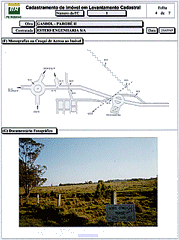
In addition to the services carried out for pipeline design projects, other surveys and products are used with the objective of controlling and monitoring right-of-way strips with existing pipelines.
The main objective of pipeline right-of-way re-surveying services is to establish a way to update the physical and legal characteristics of the properties affected by the right-of-way strip, confirming and updating all existing data.
With the generation of an updated database of this information, the right-of-way manager is able to assess improper conditions in the pipeline's area of influence, control the activities carried out in that same area, in addition to anticipating undesirable situations that could cause damage to pipeline maintenance and operation.
This activity also supports studies aimed at optimizing these strips for other activities, such as fiber optic cables and advanced telecommunication networks, as well as new pipeline installations.
Design Technologies
The availability of current and modern technologies for the preparation of pipeline projects, such as GeoRadar (GPR) and rotary-percussion drilling equipment (Geoprobe type), contributes to the development of the pipeline design area.
Thus, subsurface uncertainties are resolved already at the design stage, avoiding a lack of knowledge for the installation crews.
Together with traditional surveys, technicians carry out geotechnical zoning, which provides support for geological characterization, geomorphology and soil layering using auger/percussion drilling and electrical resistivity to determine the pipeline's cathodic protection.
Geographic Information System
Geographic Information Systems make it possible to manage and monitor pipeline right-of-way strips with great efficiency.
The GIS is composed of all the information collected during the feasibility studies stage, route study and definition, cartography and cadastre of the right-of-way strip in the project, complementary studies, engineering projects in all their categories, as well as work supervision plans.
All this information forms a unique and complete system that allows the builder and the inspection team to perfectly monitor the work "in loco," being able to verify all the details of the work, resolve construction-related doubts and carry out the necessary adjustments, based on the studies and projects carried out.
All these advantages allow for greater versatility in construction monitoring, allowing for quick and efficient decision-making during pipeline construction and inspection.
Capabilities
ESTEIO is able to provide the following products and services for the Pipeline Design and Maintenance area:
-
Specialized aerial photogrammetric services with aerial and orbital sensors at the most varied scales;
-
Image maps and digital orthophoto maps to support route and crossing studies;
-
Pipeline right-of-way re-surveying with generation of an updated database;
-
Soil investigation services;
-
Electrical resistivity services;
-
Crossing and intersection studies;
-
Staking of highway right-of-way strips;
-
Ground preparation for cuts and fills;
-
Staking of easement strips;
-
Design of service roads;
-
Design of existing and planned drainage restoration;
-
Identification of existing public utility pipelines;
-
Reconstruction of buried interferences and road improvements;
-
Preparation of a final product bringing together as-built information, so that pipeline installation companies obtain all information in a digital and quickly interpretable environment;
-
Geographic Information System covering all phases of the project, with an emphasis on control and Maintenance.
Related Articles
-
How Far Can Automation Go?
-
Law 4.321/08 – Another Aid for Land Tenure Regularization and Property Registration?
-
Aerial Photogrammetric Surveys for Topographic and Cadastral Purposes – Implementation and Management of Pipeline Right-of-Way Strips
-
Petrobras' Pipeline Network – ESTEIO's Participation in the Oil and Gas Sector
-
Health, Safety and Environment in ESTEIO's Field Activities – Overview