
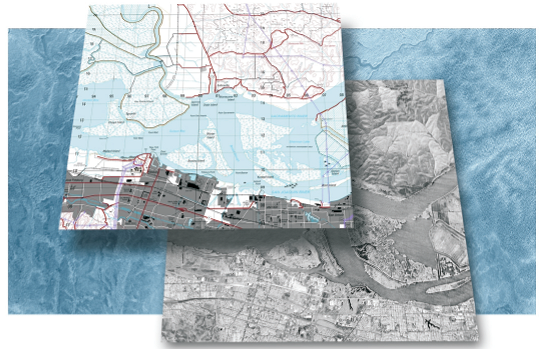
GeoSAR is an airborne radar for producing detailed DEMs and RADAR images in regions considered inaccessible, mainly due to cloud cover and dense vegetation.
The system has the capability to collect Synthetic Aperture Radar (IFSAR) data in the X band (surface) and P band (vegetation penetration) simultaneously in a single pass along each flight line, on both sides of the aircraft.
The X band (9630–9790 MHz, or a 3 cm wavelength) records the reflections from objects such as vegetation surfaces, buildings and bare ground, creating a highly detailed image with 3 m resolution.
The P band (270–430 MHz, or an 85 cm wavelength) penetrates vegetation, revealing hidden details such as roads, river meanders, and other features not apparent in X band data. Additionally, the P band reveals other physical aspects of the terrain such as moisture and density. The absence of vegetation in the P band results in a DTM that more closely resembles the actual terrain relief.
The GeoSAR system is a mapping tool for collecting geospatial data in areas where conventional cartography techniques are prohibitively expensive. Products derived from GeoSAR support applications in GIS, infrastructure development, transportation, intelligence (military cartography), environmental resource management, and other disciplines.
GeoSAR is one of the few systems that captures data on both sides of the aircraft along each flight line. This means GeoSAR can collect more data (over 4 times more) in the same flight time compared to other systems.
The radar system is also equipped with a nadir LASER Profiler. Mounted on the aircraft, the profiler records a continuous nadir terrain profile for each flight line. The profiles: (1) allow for additional terrain control and a direct measurement of vegetation density (tree height); (2) ensure measurement in small gaps between terrain features, improving the quality of the datasets; (3) provide information on vegetation and biomass; and (4) help with mosaicking.
The absence of a LASER Profiler in similar IFSAR sensors reduces the terrain control available in flight and requires more ground points, which entails additional costs.
The system is redundant and captures data up to 8 times over the same point, ensuring nearly 100% coverage. This redundancy reduces data "noise" and allows for mapping locations obstructed by vegetation and shadows, resulting in higher-quality data and time savings on re-flights.
Possible uses of SAR data include:
-
Mapping: 3D visualization, cartographic updates at medium and small scales;
-
Hydrology: watershed delineation, flood-risk areas;
-
Natural Resources: forest management, monitoring of agricultural regions, water conservation;
-
Environmental Preservation: deforestation, preservation of coastal strips (mangroves);
-
Oil & Gas: geological interpretation, seismic survey planning and preliminary pipeline routing;
-
Mineral Prospecting: extraction areas;
-
Economic Development: land use management and planning, infrastructure and development, transportation;
-
National Security: emergencies, disaster response, detection of illegal activities, reconnaissance and mission planning.
Related Articles
- GeoSAR Mapping Services: Statement of Qualifications