
Aviation and Cartography
Aviation and cartography are two intrinsically linked activities. Without maps, there would be no air navigation between two places. On the other hand, before maps, contour lines, digital terrain models, orthoimages and three-dimensional models, there is data capture by sensors mounted on airborne platforms, such as airplanes.
Founded in 1969, ESTEIO began its history focused on land surveying. With the advancement of infrastructure projects that demanded aerial photogrammetric coverage, the company entered the aerial survey segment in the late 1970s. Today, ESTEIO is one of the oldest companies still operating in aerial surveying in Brazil, establishing itself as a leader in major projects at home and abroad.
Manned Aerial Surveying
Manned aerial surveying is a highly regulated activity, categorized by ANAC (Brazil's National Civil Aviation Agency) as a Specialized Aerial Service (SAE). The aircraft used are specially adapted and registered for this purpose, incorporating cutting-edge technology for geographic data collection. Throughout its history, ESTEIO has operated different aircraft that marked distinct eras for the company. This text recalls the history of these aircraft, from the pioneers to the current fleet.
PAST FLEET
Dornier Do28-A - PT-IIP
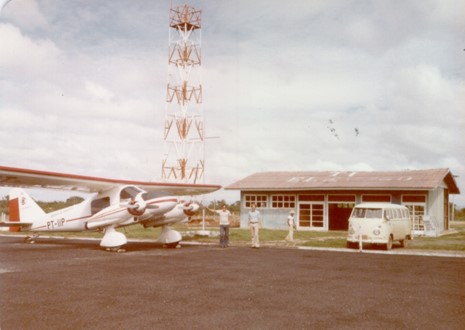
The first aircraft in ESTEIO's fleet was the German Dornier Do28-A, manufactured by Dornier-Werke GmbH. This high-wing model, designed to operate on short, unpaved runways, made its first flight in 1959. Its acquisition was motivated by the expansion of aerial photogrammetric mapping in remote regions of Brazil in the 1970s. The aircraft was equipped with Wild R5 and R8 analog sensors.
In January 1979, the PT-IIP suffered an accident during a mission in the region of Três Marias, Minas Gerais. At that time, Brazilian civil aviation was very different. During a low-altitude flight, the tip of one of the wings touched the surface of a lake, causing an accident and resulting in the destruction of the aircraft. Fortunately, there was only material damage and all crew members survived.
EMBRAER 810D - SENECA II - PT-EJE and PT-RQA
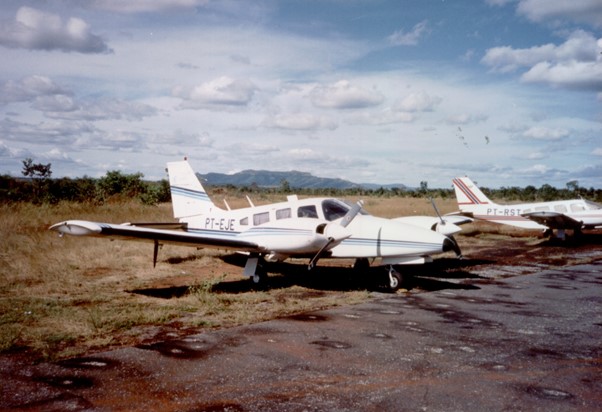
Following the incident with the Dornier and with growing demand in the infrastructure sector in the 1980s and 1990s, ESTEIO acquired new aircraft. It opted for the American and then-modern Seneca II due to greater ease of maintenance and operation. The PT-EJE was the first Seneca II added to the fleet, a model manufactured under license by EMBRAER, based on the Piper design. This aircraft still operates at another company in the sector.
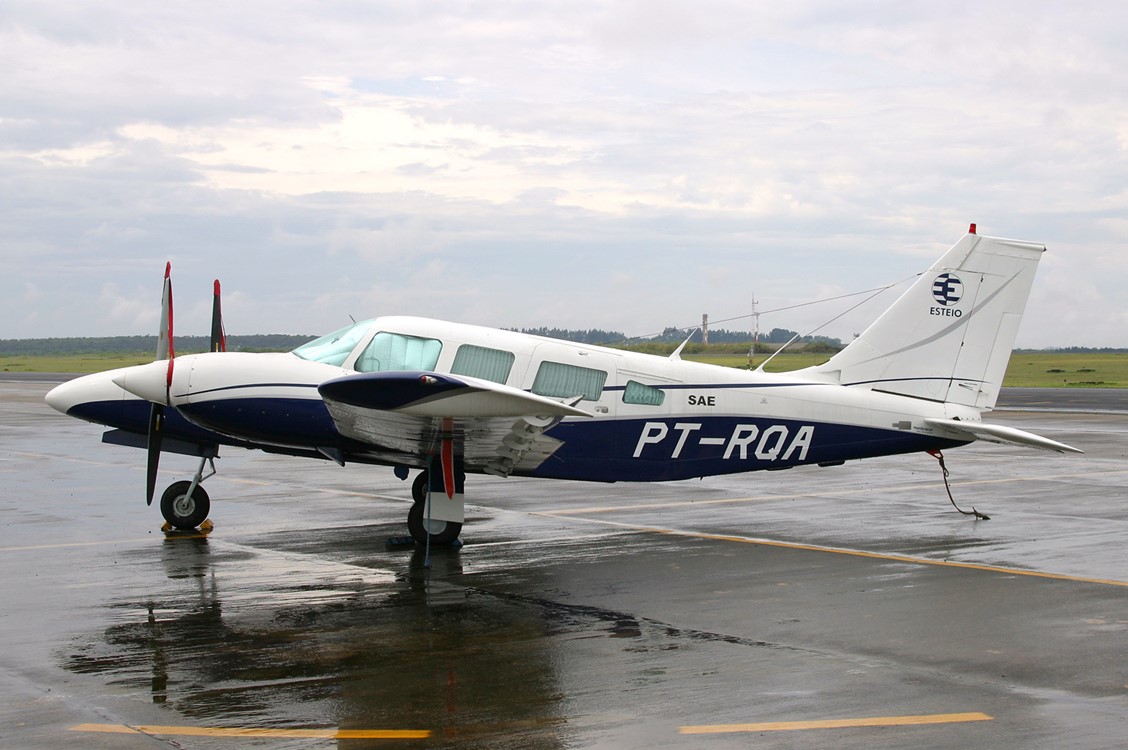
Another Seneca II, the PT-RQA, was also part of the fleet and is now operated by Engemap.
Piper PA-32-260 Cherokee Six
Known as the "Cherocão," the Piper Cherokee Six was the only single-engine aircraft operated by ESTEIO. Manufactured by Piper in the United States, it is a spacious version of the Cherokee line. It operated until 2014, when it was sold. Since 2017, it has been out of operation due to a lack of documentation renewal by its current operator.
CURRENT FLEET
EMBRAER 810D SENECA III - PT-VDO
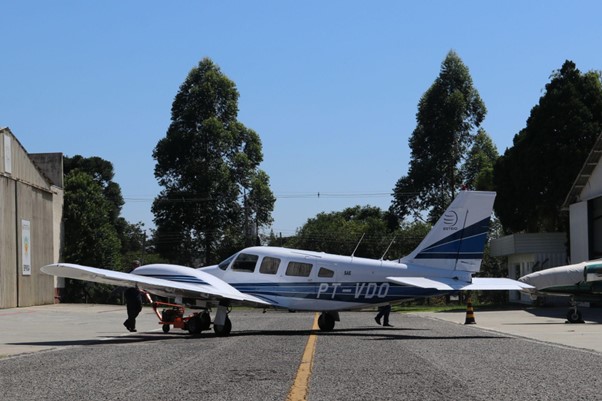
With superior performance, the Seneca III was added to the fleet in the late 1990s and remains in operation at ESTEIO. The aircraft is currently equipped with the modern Hexagon Leica ADS-100 digital aerial photogrammetric pushbroom sensor, a large-format sensor capable of capturing high-quality images in the distinct Red, Green, Blue and Near Infrared (RGBN) spectral bands. This aircraft continues to play a fundamental role in the company's missions.
EMBRAER 820C NAVAJO - PT-RAY
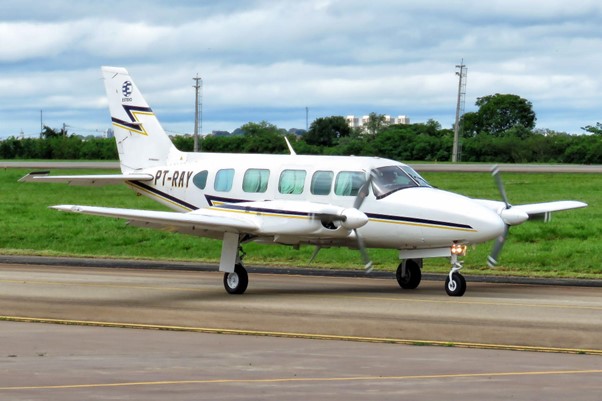
The PT-RAY is the largest aircraft the company has ever had. With a maximum takeoff weight of 3,175 kg, its tall, elongated fuselage makes the Navajo one of the most popular aircraft for aerial surveying activities in Brazil and around the world.
It was the PT-RAY that started ESTEIO's LASER Profiling era in 2001, with the acquisition of the Optech ALTM 2025 LiDAR system. It also marked the beginning of digital photogrammetry at the company in 2006, as it was equipped with the iconic Hexagon Leica ADS-40 pushbroom imager.
In aeronautical jargon, the smaller model, manufactured in the United States, is referred to as "Navajinho," while the larger model, manufactured in Brazil, is called "Navajão."
It is a powerful aircraft, with 350 hp Lycoming engines and Hartzell tri-blade propellers, capable of flying above 10,000 feet in altitude and reaching speeds over 150 knots. It also operates on runways shorter than 1,000 meters.
At ESTEIO, the PT-RAY is the primary platform for the LASER profiling and oblique imaging sensor, the Leica City Mapper 2, and can also operate with the ADS-100. A curious fact is that its registration, RAY, means "ray" in English, associating it with the LASER pulses emitted by the profiler. Its paint scheme, with yellow and blue stripes, evokes shooting rays, reinforcing its purpose at ESTEIO.
By Iolaus Pasanisi